
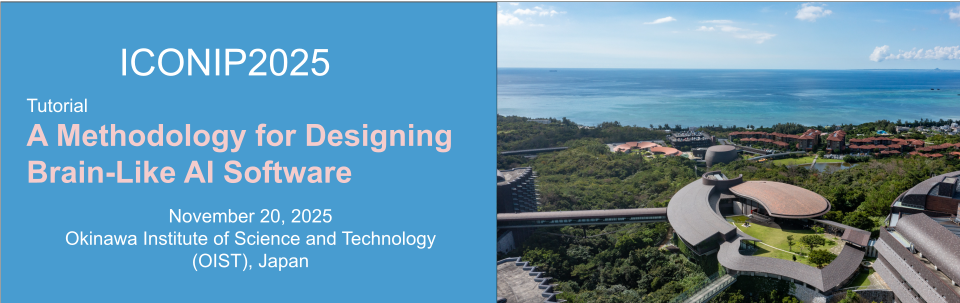
10:00-13:00, November 20, 2025
Main Campus C210, Okinawa Institute of Science and Technology (OIST), Japan
Introduction
At ICONIP2025, we are hosting a tutorial titled “A Methodology for Designing Brain-Like AI Software.” This tutorial will provide a structured overview of BRA (Brain Reference Architecture)-driven development for designing brain-morphic AI software. Participants will engage in hands-on exercises to evaluate BRA datasets based on anatomical and computational criteria.
Tutorial Overview
This tutorial introduces a structured methodology for designing and evaluating brain-inspired software based on Brain Reference Architecture (BRA). This standardized framework draws on whole-brain mesoscopic anatomy to guide the design of AI systems. BRA-driven development begins with the construction of Brain Information Flow (BIF) data derived from anatomical connectivity. It proceeds to formulate Hypothetical Component Diagrams (HCDs) that represent functional hypotheses aligned with this structure. Functionalities of HCDs are designed with bidirectional manner (i.e. bottom-up and top-down design) to construct Function Realization Graph (FRG) that represents the functional relationship of HCDs.
In this session, we will conduct a hands-on activity to enable participants to evaluate BRA data, a process referred to as BRA data review. Participants will learn how to construct BIF and HCD elements and will engage in practical exercises to assess BRA datasets based on criteria such as anatomical plausibility, computational coherence, and applicability to brain-like AI system design. We will also introduce emerging methods for describing HCD components using probabilistic generative models, which support structured modeling of uncertainty in brain-inspired systems.
Direct Learning Outcomes — Participants will deepen their theoretical understanding of the Brain-Referenced Architecture (BRA) and acquire hands-on skills for
- constructing Brain Information Flow (BIF) diagrams,
- designing Hypothetical Component Diagrams (HCDs) and Function Realization Graph (FRG),
- and critically reviewing BRA datasets with respect to anatomical plausibility, computational coherence, and AI applicability.
Conference Dates & Venue
Conference Dates & Venue
- Conference Dates: November 20th, 10:00-13:00
- Venue: Main Campus C210, OIST Conference Center, Okinawa, Japan
Program
| Time | Title | Speakers |
| Part I | Introduction | |
| 10:00 | Opening remarks and the role of BRA-driven development within the WBA roadmap | Hiroshi Yamakawa |
| 10:15 | Overview of the theoretical background of BRA-driven development | Yoshimasa Tawatsuji |
| 10:35 | Invited talk: Practical case studies of BRA-driven development | Yasuhiro Tanaka |
| Part II | Data Review Exercise (Hands-on) | |
| 11:00 | Outline of the exercise and procedural guidance | Yoshimasa Tawatsuji |
| 11:20 | Hands-on peer review and revision of BRA datasets BRA data for Review Tutorial | |
| Part III | Data Utilization | |
| 12:05 | The Whole-Brain BIF as fundamental infrastructure and future perspectives | Yuta Ashihara |
| 12:20 | Approaches to constructing a Whole-Brain Probabilistic Generative Model (WB-PGM) | Akira Taniguchi |
| 12:35 | Applications to safety assessment | Takeshi Nakashima |
| 12:50 | Summary and closing remarks | Hiroshi Yamakawa |
Program Committee:
Organizers:
- Yoshimasa Tawatsuji (The University of Tokyo / The Whole Brain Architecture Initiative)
- Yoshimasa Tawatsuji is an assistant professor at Graduate School of Engineering, The University of Tokyo. He received his Ph.D. in Human Sciences from Waseda University in 2020. He is a member of The Whole Brain Architecture Initiative, a non-profit organization.
- Hiroshi Yamakawa (The University of Tokyo / The Whole Brain Architecture Initiative)
- Hiroshi Yamakawa is the Chairperson of The Whole Brain Architecture Initiative (WBAI), a non-profit organization, a Visiting Professor of the University of Electro-Communications and a Visiting Professor of the Kindai University. He received an MS in physics and PhD in engineering from the University of Tokyo in 1989 and 1992 respectively. His research interest is brain-inspired artificial general intelligence and concept formation.
- Yudai Suzuki (The University of Tokyo / The Whole Brain Architecture Initiative)
- Yudai Suzuki is a member of The Whole Brain Architecture Initiative, a non-profit organization.

 Japanese