
Yoshimasa Tawatsuji, Akira Taniguchi, Takeshi Nakashima, Yudai Suzuki, Yuta Ashihara, Hiroshi Yamakawa
WBAI (Whole Brain Architecture Initiative) organized three major programs—a Tutorial, a Special Session, and a Workshop—at ICONIP2025 (International Conference on Neural Information Processing), held at the Okinawa Institute of Science and Technology (OIST). We also participated in research presentations and a public forum.
In the Tutorial, we systematically presented the BRA (Brain Reference Architecture)-driven development methodology at an international conference for the first time, sharing practical skills through hands-on exercises. The Special Session deepened international discussions on the safety and interpretability of brain-inspired AI, demonstrating the unique value of human brain-inspired AI. At the Workshop, five BRA datasets were presented, sharing concrete advances in brain-inspired AI research. In the poster session, a method for automatically estimating correspondences between neocortical regions across species was presented, contributing to the development of WholeBIF. At the open forum, Representative Yamakawa served as panel discussion coordinator, facilitating a discussion on human-AI symbiosis.
This report covers the international dissemination of brain-inspired AI development promoted by WBAI, the safety and interpretability of brain-inspired AI, and the deepening discussions toward human-AI symbiosis. Participation in ICONIP2025 marked an important step in communicating the feasibility and value of brain-inspired AI both domestically and internationally, and in further advancing the growing global community of brain-inspired AI research.
1. The Significance of WBAI’s Participation in ICONIP
ICONIP is a long-established international conference on neural information processing, primarily centered in the Asia-Pacific region, bringing together researchers from a wide range of fields including deep learning, brain information processing, robotics, and cognitive science. ICONIP2025 was held under the theme “Harmony of Humans, AI, and Society,” fostering broad discussions spanning from brain science to social implementation.
WBAI promotes “Human Brain-morphic AI,” which applies insights from brain science to AI development. Our participation this year was driven by the following objectives:
- Increasing international recognition of brain-inspired AI development methodology (BRA-driven development)
- Reaffirming to the global community the significance of brain-inspired AI
- Deepening collaboration with the research community
This report aims to present WBAI’s activities in an accessible manner for general participants and readers interested in brain science and AI, explaining technical content in plain terms.
2. Tutorial: “A Methodology for Designing Brain-Like AI Software”
Link:Tutorial “A Methodology for Designing Brain-Like AI Software” @ICONIP2025 | 全脳アーキテクチャ・イニシアティブ
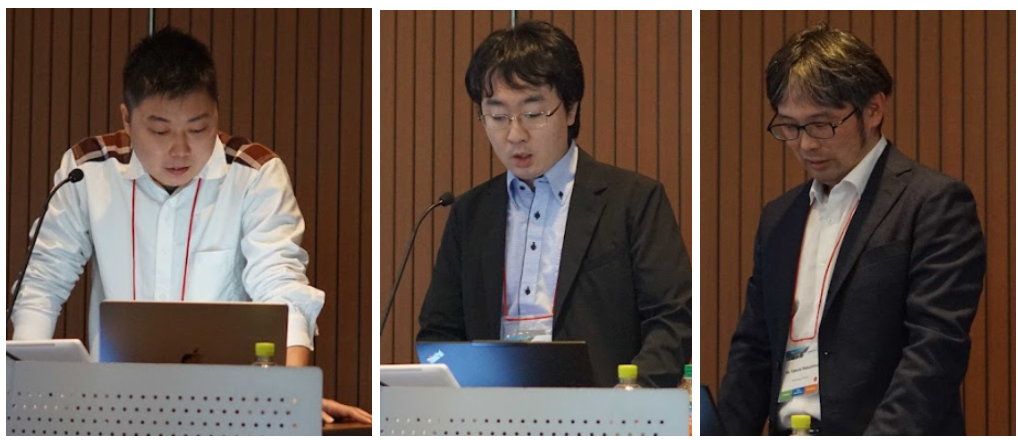
Tutorial Overview
Tutorial Title: A Methodology for Designing Brain-Like AI Software
Date and Time: November 20, 2025 (Thursday), 10:00–13:00
Organizers: Yoshimasa Tawatsuji (The University of Tokyo / WBAI), Hiroshi Yamakawa (The University of Tokyo / WBAI), Yudai Suzuki (The University of Tokyo / WBAI)
This tutorial was designed to systematically explain the brain-inspired AI development methodology based on the “BRA (Brain Reference Architecture)” promoted by WBAI. BRA is a framework that organizes the information processing structure of the human brain in a form that can be reused for software design, serving as a “design specification” for developing brain-inspired AGI. The theory and practice of BRA-driven development were presented to a broad audience ranging from beginners in brain science and AI to early-career researchers.
Content
The tutorial was conducted in three parts.
Part I: Introduction featured Hiroshi Yamakawa explaining the positioning of BRA-driven development within the WBA roadmap, followed by Yoshimasa Tawatsuji providing an overview of the theoretical background of BRA-driven development. BRA data consists of BIF (structural knowledge of the brain), HCD (functional hypotheses), and FRG (Function Realization Graph). While approximately 12 BRAs currently exist toward the goal of formulating initial design specifications for AGI approaching the human brain by 2027, many regions remain uncovered compared to the approximately 400 functional areas of the human brain. To address this challenge, the necessity of building an ecosystem that involves neuroscientists as reviewers was presented.
In the invited talk, Yasuhiro Tanaka introduced specific examples of BRAs developed to date, including the brainstem circuit for the vestibulo-ocular reflex (VOR), spatial cognition models of the hippocampal formation, motif-driven modeling of the amygdala, and cortical microcircuit modules. He also shared the development of a basal ganglia BRA in collaboration with Professor Atsushi Nambu of the National Institute for Physiological Sciences. Meanwhile, ensuring scalability—a system where third parties can independently create BRAs—was identified as a future challenge.
Part II: Data Review Exercise (Hands-on) employed a “Learning by Reviewing” approach, allowing participants to experience BRA data review firsthand. After explaining the structure of BRA data papers and review criteria (understandability, reproducibility, transparency), participants conducted manual reviews of BIF, HCD, and FRG using BRA data on the vestibulo-ocular reflex, practically acquiring skills to evaluate from perspectives of anatomical validity and computational consistency.
Part III: Data Utilization featured Yuta Ashihara presenting on WholeBIF-RDB (Whole-Brain Information Flow Relational Database), reporting progress on automated collection of projection data toward whole-brain coverage and the development of tools that other researchers can easily use and extend. Akira Taniguchi introduced the Whole-Brain Probabilistic Generative Model (WB-PGM), presenting two directions—brain-inspired AI and PGM-based approaches—in response to the questions “What cognitive modules should be implemented?” and “How should they be integrated?” Takeshi Nakashima introduced spatial cognition model construction inspired by the hippocampal formation using the SCID method and GIPA, as well as research on robust self-localization under teleportation conditions.
Outcomes and Response
Approximately 10 participants attended, representing a diverse range including AI researchers, neuroscientists, and students. The hands-on exercise in particular generated lively discussions among participants, reflecting strong international interest in the integration of brain science and AI.
For WBAI, this was a highly significant event as it marked the first systematic presentation of BRA-centered brain-inspired AI development methodology at an international conference, including demonstrating the direction for building an ecosystem that involves neuroscientists.
3. Special Session: “Toward Safe Brain-Inspired AI”
Link:Special Session “Toward Safe Brain-Inspired AI” @ICONIP2025
Session Overview
Session Title: Toward Safe Brain-Inspired AI
Date: November 20, 2025
Organizers: Hiroshi Yamakawa (The University of Tokyo / WBAI), Akira Taniguchi (Ritsumeikan University), Takeshi Nakashima (Ritsumeikan University)
The issue of “safety” is unavoidable when realizing brain-inspired AI. This session featured discussions on the transparency and interpretability of AI models based on brain science, as well as design philosophies aimed at coexistence with humanity. International researchers, including WBAI Representative Hiroshi Yamakawa, took the stage to illustrate the cutting edge and future of brain-inspired AI research.
Research Presentations
In the session introduction, WBAI Representative Yamakawa explained that even as AI becomes extremely advanced, Human Brain-morphic AI can maintain certain values and characteristics—such as Phenomenal Human Experiencing, brain-based interpretability, and mediator functions—and that these connect to human safety. [slide]
In the invited talk, Taiyo Hamada from ARAYA presented “Neuro-aligned AI for machine neuroscience,” introducing the concept of “Neuro-aligned AI,” which aligns AI systems with brain representations, dynamics, and human behavior. Dr. Hamada obtained his PhD in systems neuroscience from OIST and currently serves as a principal investigator in the Cabinet Office’s Moonshot Research and Development Program. He proposed a framework that bridges advanced AI systems and the human nervous system by treating AI as a model of the brain. [slide]
Three general presentations were given:
- “Interpretable Anomaly Detection in a Hippocampal Formation-Inspired Spatial Cognition Model” (Takeshi Nakashima, Akira Taniguchi, Tadahiro Taniguchi, Hiroshi Yamakawa) presented research that models the structure of the brain’s hippocampus and maps anomaly detection sites to neuroscience, enabling AI that can not only detect anomaly occurrences but also estimate “what type of anomaly” has occurred. [slide]
- “Alignment with Psychological Concept Network” (Taiyo Hamada, Yuto Harada) proposed an approach that uses psychological concept networks to align AI’s internal representations with human conceptual structures, making AI behavior easier to understand and predict. [slide]
- “Decentralized Belief Propagation in LLM Agents: A Brain-Inspired Approach to AI Safety Analysis” (Yusuke Hayashi) proposed a method for evaluating and improving the safety of LLM agents, drawing on the brain’s distributed information processing structure. [slide]
Panel Discussion
The panel discussion featured three speakers (Taiyo Hamada, Yusuke Hayashi, and Takeshi Nakashima) discussing the theme “How much must we understand the brain’s mechanisms to create safe, controllable AI?” Lively discussions ensued, including audience participation, on the necessity of understanding the brain and on controllable AI.
Outcomes and Response
This session played a role in advancing international discussions on the safety of brain-inspired AI. The perspective of “how to achieve safe and transparent AI by learning from brain science” is an important viewpoint currently lacking in AI safety research.
Approximately 30–40 participants attended, with numerous questions raised, and a shared recognition emerged that “safe social implementation of brain-inspired AI is an important theme.”
4. The Third International Whole Brain Architecture Workshop
Link:The Third International Whole Brain Architecture Workshop in ICONIP2025
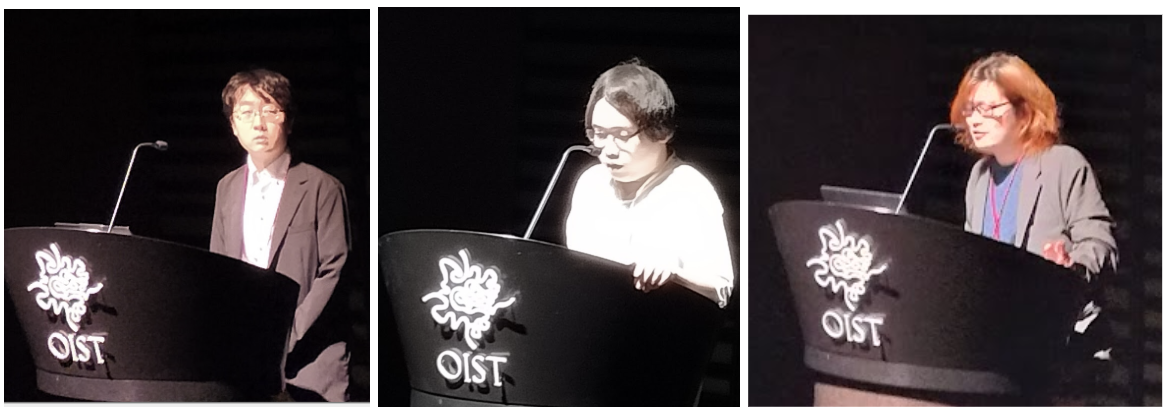
■
Overview
Workshop Title: The Third International Whole Brain Architecture Workshop
Date and Time: November 24, 2025 (Monday), 9:00–12:00
Organizers: Yoshimasa Tawatsuji (The University of Tokyo / WBAI), Hiroshi Yamakawa (The University of Tokyo / WBAI)
This is the third annual workshop serving as an international research exchange forum for brain-inspired AI led by WBAI. Its objectives are to promote BRA, build networks among brain-inspired AI researchers, and nurture early-career researchers.
Content
The workshop featured research on themes including implementation examples of brain-inspired AI models using BRA, AI model construction using brain science data, cross-disciplinary research spanning cognitive science, neuroscience, and AI, and the opening and standardization of brain information.
In the invited talk, Akira Taniguchi (Ritsumeikan University) presented “From Whole-Brain Architecture to General-Purpose Intelligent Robots,” discussing the latest developments in BRA-driven development. He introduced the development prospects and current status of the Whole Brain Probabilistic Generative Model (WB-PGM), incorporating practical examples of robotics applications of BRA data using the hippocampal formation probabilistic generative model. He also discussed the vision of implementing computational models based on BRA in robots and updating whole-brain models by feeding back empirical results to BRA data, as well as the importance of considering both the brain and embodiment. [slide]
Five research presentations were shared as oral presentations:
“Capability constraints reduce implementation search in neural circuits for efficient brain-inspired software design” (Maruyama, Tawatsuji, Yamakawa) formalized the “Capability-Constrainedness” principle, which states that when requirements are fixed in BRA development, the range of achievable biological parameters becomes constrained. Using global feedback inhibition and Winner-Take-All functionality as case studies, the research proposed a method for reducing the parameter search space during implementation. (paper)
“Data for Brain Reference Architecture of YS25SHCOMv0” (Suzuki, Kariyama, Ashihara, Yamakawa) constructed a BIF dataset of the human cerebral cortex by representing brain atlases of humans, macaques, and marmosets as graph structures, establishing cross-species correspondences using Deep Graph Matching Consensus (DGMC), and integrating hierarchical and connectivity structures. (data and paper)
“Data for Brain Reference Architecture of MI25Imagination” (Inoue, Tawatsuji) constructed BRA data for computational architectures related to imagination. Using the neocortex, globus pallidus, basal ganglia-thalamic complex, and hippocampal formation as ROIs, the research reverse-engineered the brain’s imagination function using the Function-oriented SCID method. (data and paper)
“Data for Brain Reference Architecture of SK25LHbDepressionModel” (Ko, Tawatsuji, Matsui) is a structural information dataset focusing on brain regions associated with Major Depressive Disorder (MDD), particularly the lateral habenula (LHb). The research organized connectivity information of LHb circuits based on neuron-glia (astrocyte) interactions. (data and paper)
“Data for Brain Reference Architecture of TM25CILsSpiralingHypothesis” (Miyamoto, Tawatsuji, Yamakawa) described the “spiraling hypothesis,” the neural basis of habit formation in the basal ganglia, in BRA format. The research implemented the striatonigral-striatal (SNS) pathway that mediates the transition from goal-directed to habitual behavior as BIF.(data and paper)
These data are publicly available through BRAES (BRA Editorial System).
Panel Discussion
The panel discussion began with a topic presentation on the brain region coverage status achieved by BRA data to date, and the relationship between BCM (Brain Constrained Model) and BAM (Brain Agnostic Model).
The discussion primarily addressed two questions:
Q1: Procedures for BRA data design and architecture implementation When designing BRA data, circuits registered in WholeBIF (the whole-brain information flow diagram) may be insufficient. It was shared that additional methods include automatic extraction from literature, hypothetical registration through correspondence with other animal species, and hypothetical registration from computational perspectives.
Q2: Model selection (BCM vs BAM) The discussion addressed which approach to choose in brain-inspired AI development: BCM (Brain Constrained Model: models that follow anatomical and functional constraints of the brain) or BAM (Brain Agnostic Model: models that prioritize functional realization without depending on brain constraints). BCM follows brain constraints, making it relatively easy to establish correspondences with experimental results such as neural activity, but implementation involves many constraints. On the other hand, BAM has fewer constraints, making implementation relatively easier, but the high degree of freedom results in a wider parameter search space to achieve desired behaviors. It was recognized that both approaches have trade-offs, and appropriate selection based on objectives is important.
Outcomes and Response
Approximately 15 participants attended in person and 2 online, with researchers joining from various countries. The high level of researcher interest in BRA-driven development as a new methodology was reconfirmed.
5. Research Presentations at ICONIP2025
Poster Presentation
“Estimating Cortical Hierarchy in the Human Cerebral Cortex Using Deep Graph Matching Consensus” was presented as a poster by Yudai Suzuki (The University of Tokyo / WBAI) and colleagues. Co-authors are Minato Kariyama, Yuta Ashihara, and Hiroshi Yamakawa. [slide]
To construct brain-inspired AI models, it is important to understand the hierarchical structure of the cerebral cortex (which regions are upstream or downstream in information processing). This hierarchical structure has been studied in detail in non-human primates such as macaques and marmosets, but there is a problem that brain region nomenclature does not correspond across species.
In this research, brain atlases were represented as graph structures, with brain regions as nodes, adjacency relationships between brain regions as edges, and naming information as features. Using an algorithm called Deep Graph Matching Consensus (DGMC), we developed a method to automatically estimate correspondences between brain regions across different species and different brain atlases.
Specifically, in Step 1, DGMC was used to obtain brain region correspondence matrices between humans, macaques, and marmosets. In Step 2, these correspondence matrices were used to transform the hierarchy from non-human primates to the human hierarchy.
This enables knowledge of hierarchical structures that have been studied in detail in non-human primates to be applied to understanding the human brain. This achievement contributes to the development of WholeBIF, which serves as the foundation for brain-inspired AI design.
6. Open Forum “Society of Humans and AI Agents
Link:Open forum 公開フォーラム – ICONIP 2025
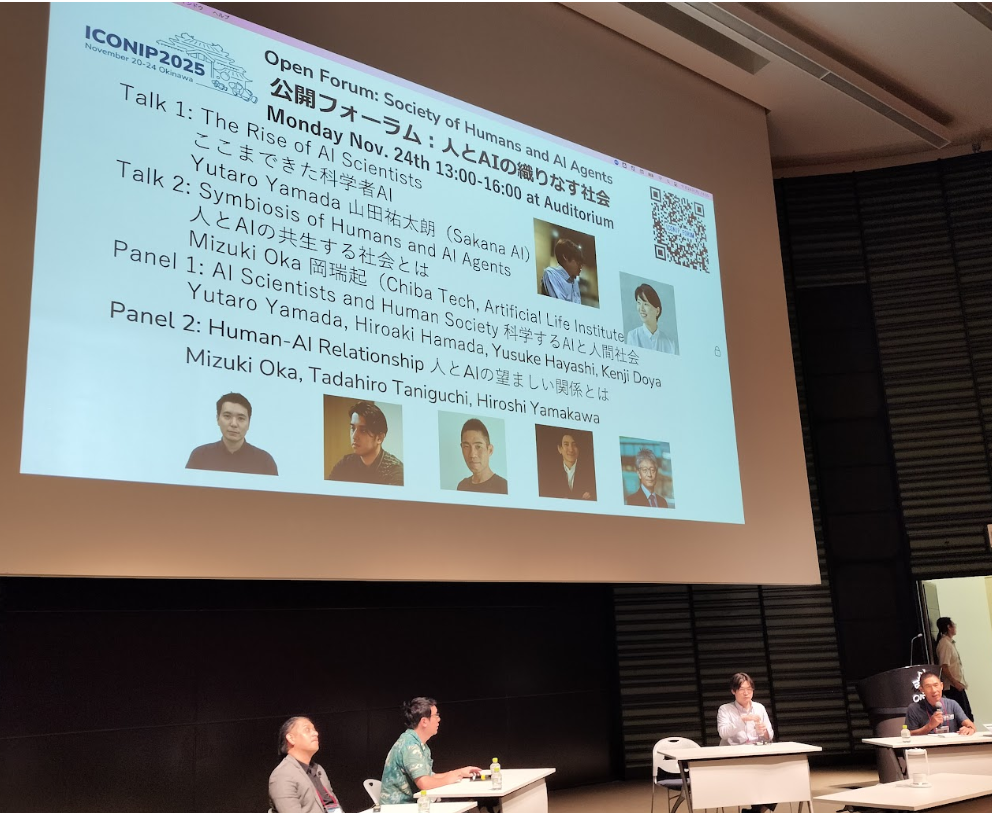
Panel 1 in session: from left, Yusuke Hayashi, Taiyo Hamada, Yutaro Yamada, Kenji Doya
Forum Overview
Forum Title: A Society Woven by Humans and AI (Society of Humans and AI Agents)
Date and Time: November 24, 2025 (Monday, National Holiday), 13:00–16:00
Venue: Okinawa Institute of Science and Technology (OIST) Auditorium
Today, AI has become a technology that everyone uses without even realizing it, and we have entered an era where AI is integral to our daily lives, business, education, politics, culture and arts, and cutting-edge science and technology. Taking advantage of ICONIP2025 being held at OIST, an open forum was organized where researchers, citizens, and students came together to learn and discuss how AI will evolve, how we should engage with AI, and how we can predict and mitigate the dangers and adverse effects of AI.
Presentations
Yutaro Yamada (Sakana AI) presented “How Far AI Scientists Have Come,” introducing cutting-edge research trends including LLM agents, self-improving AI, and automation of scientific discovery. Mizuki Oka (Chiba Institute of Technology, Artificial Life Institute) presented “What Does a Society Where Humans and AI Coexist Look Like,” discussing the impact of AI on human creativity from the perspectives of artificial life and Open-Endedness.
Panel Discussion 1: “AI That Does Science and Human Society”
Coordinator: Kenji Doya (OIST, ICONIP2025 General Chair)
Panelists: Yutaro Yamada (Sakana AI), Taiyo Hamada (ARAYA), Yusuke Hayashi (AI Alignment Network)
The discussion addressed the potential of AI that automates and accelerates scientific research (scientist AI) and its impact on human society. The nature of collaboration between science and AI was examined from multiple perspectives, including whole-brain dynamics research, digital twins using generative AI, and theoretical research on exploration and emergence in AI agents.
Panel Discussion 2: “What Is the Desirable Relationship Between Humans and AI?”
Coordinator: Hiroshi Yamakawa (The University of Tokyo, AI Alignment Network)
Panelists: Mizuki Oka (Chiba Institute of Technology, Artificial Life Institute), Tadahiro Taniguchi (Kyoto University, ICONIP2025 Program Chair)
Representative Yamakawa presented an argumentative framework called “Symbiosis Selection Logic.” Based on the premises that the emergence of superintelligence is inevitable and that it will be difficult for humanity to continuously control superintelligence and catastrophic technologies, this logic holds that “symbiosis with friendly superintelligence is the most promising future for humanity.” He also advocated for a “paradigm shift from control to symbiosis,” demonstrating the necessity of transitioning from conventional unidirectional control to cooperative order through bidirectional interaction. [slide]
The discussion addressed themes such as whether AI is a “tool” or an “autonomous partner,” whether AI can possess values and ethics that are friendly toward humans, and what researchers can do to foster “desirable relationships between humans and AI.”
Outcomes and Response
This forum featured multifaceted discussions on the future of humans and AI from two perspectives: “AI that does science” and “AI that coexists.” The future toward which AI is heading is open to both positive and negative directions, and what matters is not whether to “control” or “reject” AI, but rather that we ourselves choose “what kind of relationship we want to build”—this message was shared through dialogue between researchers and citizens.
7. Summary and Future Prospects
Through participation in ICONIP2025, WBAI was able to clearly demonstrate the following three points internationally:
1. Brain-inspired AI (brain-like AI) is achievable. At the Workshop, five BRA datasets were presented, demonstrating that diverse brain functions—including cortical hierarchy estimation, imagination, depression-related circuits, and habit formation—can be described as concrete software design specifications. The poster presentation also introduced a method for automatically estimating cross-species brain region correspondences, showing steady progress in foundational technologies toward whole-brain coverage. Brain-inspired AI is gradually transitioning from the design stage to the implementation phase.
2. BRA as a development methodology is attracting international interest. Active discussions took place across all programs, with approximately 10 participants at the Tutorial, 30–40 at the Special Session, and 15 in-person plus 2 online at the Workshop. Essential questions were discussed, such as “How much must we understand brain mechanisms to create safe AI?” and “How should we choose between BCM and BAM?” We felt that BRA-driven development is increasingly being recognized as an international research agenda.
3. Brain-inspired AI holds long-term value for the future of humanity. The Special Session demonstrated the unique values of Human Brain-morphic AI, including the shareability of human experience, brain-based interpretability, and the mediator function between humanity and AI. At the Open Forum, a “paradigm shift from control to symbiosis” was advocated, and the prospect was shared that even in an era of increasingly advanced AI, AI that references the human brain will enhance the potential for sustainable coexistence with humanity.
What deserves particular emphasis is that the value of Human Brain-morphic AI “will remain valuable as long as humanity exists.” The brain is an information processing mechanism that has been refined over millions of years, and AI that references its structure possesses irreplaceable value in terms of compatibility with humanity and understandability that cannot be substituted by other approaches.
WBAI will continue to promote the realization of Human Brain-morphic AGI, serving as a bridge between brain science and AI research, and as a bridge between humanity and AI.
References
- Takeshi Nakashima, Akira Taniguchi, Tadahiro Taniguchi, Hiroshi Yamakawa: Interpretable anomaly detection in a hippocampal formation-inspired spatial cognition model, In: Lecture Notes in Computer Science, Springer Nature Singapore, pp. 509–522, 2025. (paper)
- Yudai Suzuki, So Kariyama, Yuta Ashihara, Hiroshi Yamakawa: Estimating cortical hierarchy in the human cerebral cortex using deep graph matching consensus, In: Communications in Computer and Information Science, Springer Nature Singapore, pp. 188–200, 2025. (paper)
- Yohei Maruyama, Yoshimasa Tawatsuji, Hiroshi Yamakawa: Capability constraints reduce implementation search in neural circuits for efficient brain-inspired software design, 3rd. Int. Whole Brain Architecture Workshop, WBA-WS-003-01, November 2025. (paper)
- Yudai Suzuki, So Kariyama, Yuta Ashihara, Hiroshi Yamakawa: Data for Brain Reference Architecture of YS25SHCOMv0, 3rd. Int. Whole Brain Architecture Workshop, WBA-WS-003-02, November 2025. (data and paper)
- Misaki Inoue: Data for Brain Reference Architecture of MI25Imagination, 3rd. Int. Whole Brain Architecture Workshop, WBA-WS-003-03, November 2025. (data and paper)
- Seii Ko, Yoshimasa Tawatsuji, Tatsunori Matsui: Data for Brain Reference Architecture of SK25LHbDepressionModel, 3rd. Int. Whole Brain Architecture Workshop, WBA-WS-003-04, November 2025. (data and paper)
- Tatsuya Miyamoto, Yoshimasa Tawatsui, Hiroshi Yamakawa: Data for Brain Reference Architecture of TM25CILsSpiralingHypothesis, 3rd. Int. Whole Brain Architecture Workshop, WBA-WS-003-05, November 2025. (data and paper)
New e Initiative

 Japanese